
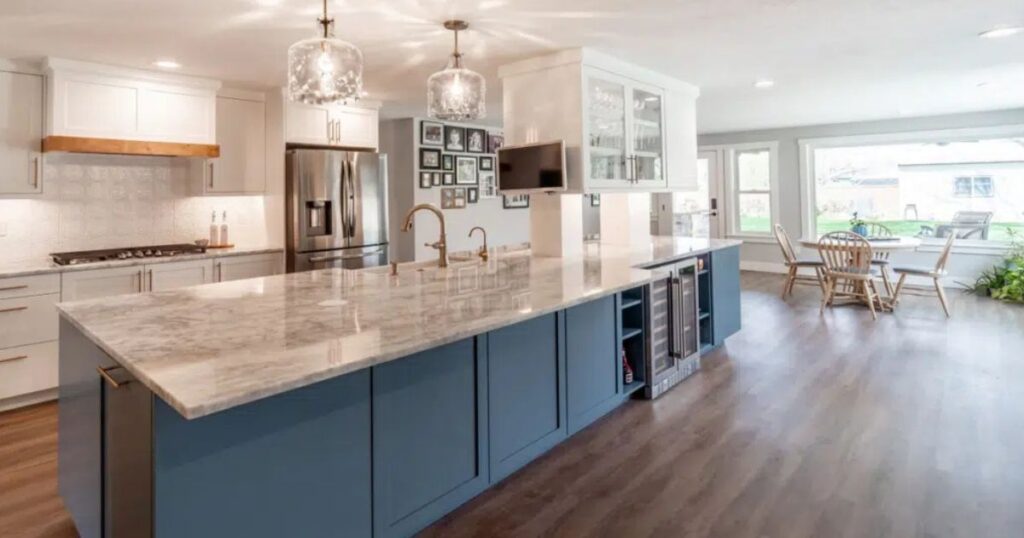
Kitchens in Boise work hard. They host weeknight dinners after soccer practice, early-morning coffee before work, and full-house gatherings when friends come over for a Broncos game. Because cabinets take up so much visual space—and handle the most daily wear—they’re one of the most important choices you’ll make in a kitchen remodel.
At Renaissance Remodeling, we treat cabinet selection like a design-and-function decision, not a catalog decision. The “right” kitchen cabinets should fit your home’s style, your storage needs, and your expectations for quality. This guide walks you through how to choose confidently, avoid expensive regrets, and end up with a kitchen that feels tailored to the way Boise families actually live.
READ: How to Plan a Kitchen Remodel Step by Step
Kitchens in Boise work hard. They host weeknight dinners after soccer practice, early-morning coffee before work, and full-house gatherings when friends come over for a Broncos game. Because cabinets take up so much visual space—and handle the most daily wear—they’re one of the most important choices you’ll make in a kitchen remodel.
At Renaissance Remodeling, we treat cabinet selection like a design-and-function decision, not a catalog decision. The “right” kitchen cabinets should fit your home’s style, your storage needs, and your expectations for quality. This guide walks you through how to choose confidently, avoid expensive regrets, and end up with a kitchen that feels tailored to the way Boise families actually live.
How to Choose the Right Kitchen Cabinet For Your Kitchen
If you only read one section, make it this one. Cabinet decisions get easier when you choose in the right order.
Start with your kitchen’s daily function
Before door styles and paint colors, get clear on what you need the kitchen to do better than it does today.
Ask:
- What’s frustrating right now—messy counters, awkward corners, not enough pantry space, drawers that don’t hold pots?
- Who uses the kitchen most, and how—serious cooking, entertaining, quick meals, kids grabbing snacks?
- What needs to be more efficient—prep space, storage, traffic flow, cleanup?
A cabinet plan built around real habits feels good every day. A cabinet plan built around looks alone can photograph well and still function poorly.
Choose the right cabinet quality level for your lifestyle
Cabinets come in “tiers,” and the right tier depends on timeline, budget, and how long you plan to stay.
- Short-to-medium term home (or tighter budget): a strong semi-custom line can deliver durability and style without the cost of true custom.
- Long-term home (and you care deeply about layout + storage): custom cabinetry can solve tricky spaces and deliver a truly tailored look.
- Simple cosmetic refresh: refacing or partial replacement can work if your existing cabinet boxes are sturdy and the layout is staying.
In Boise, we often see homeowners investing in a kitchen they plan to enjoy for years—so we prioritize cabinet construction and functional storage upgrades that hold up through daily life.
Match cabinet style to Boise home architecture
Boise has a wide mix of homes—North End charmers, mid-century ranches on larger lots, foothills contemporary builds, and newer suburban homes in Meridian and Eagle. Cabinets should feel like they belong in your home, not like they were dropped in from a different decade.
A few reliable pairings:
- North End / traditional homes: Shaker, slim Shaker, or inset-style looks with warm whites, soft colors, or stained wood accents.
- Ranch / mid-century: cleaner lines, slab or simple Shaker, warmer wood tones, and thoughtful minimal hardware.
- Modern / foothills contemporary: flat-panel or slim Shaker, frameless construction, strong organization, and intentional contrast.
Great design doesn’t mean trendy—it means cohesive.
Balance aesthetic and function
Boise homeowners often tell us the same thing after a remodel: the storage changes are what they love most.
When choosing cabinets, pay special attention to:
- Deep drawers for pots, pans, and dishes (more usable than lower-door cabinets)
- Trash/recycling pull-outs near the sink
- Pantry planning that fits your groceries, small appliances, and “Costco runs”
- Landing zones (where things naturally get set down): near the fridge, sink, oven, and coffee station
Function is what makes a kitchen feel “luxury,” even more than a high-end finish.
Cabinet Types Explained: Stock vs. Semi-Custom vs. Custom
The cabinet category you choose affects cost, lead time, design flexibility, and overall finish quality.
Stock cabinets usage
Stock cabinets are pre-sized and mass-produced. They can be a decent fit when:
- the kitchen layout is simple
- you’re doing a quick update
- you’re comfortable designing around limited sizes
Trade-offs to know:
- fillers are common (wasted space)
- fewer storage solutions
- finish options are limited
- quality varies widely—especially in drawer hardware and box construction
Stock can work, but it’s rarely the best choice for a full kitchen remodel where you want the space to feel tailored.
Semi-custom cabinets usage
Semi-custom cabinets offer flexibility in sizes, storage features, and finishes—without the full cost of custom.
Why many Boise homeowners choose semi-custom:
- better fit to your room (fewer awkward filler panels)
- more door styles and colors
- strong functional upgrades (roll-outs, divider drawers, pantry solutions)
- solid value for a long-term kitchen
If you want a kitchen that feels thoughtful and elevated, semi-custom is often the most cost-effective path.
Custom cabinets usage
Custom cabinetry is built to your kitchen, your storage needs, and your design vision. Custom becomes worth it when:
- your layout is complex or your walls/floors are out of level (common in older Boise homes)
- you want specific details (furniture-style ends, inset looks, integrated panels)
- you need exact sizing (unique pantry dimensions, ceiling-height cabinets, special appliance enclosures)
- you care about a truly seamless, high-craftsmanship finish
Custom also shines when you want a statement—like a showpiece island, a built-in coffee bar, or a pantry wall that looks clean and architectural.
What “cabinet customization” actually means
Homeowners often hear “custom” and think it’s only about door style or color. The real power is in the planning:
- cabinet depths adjusted for your walkways
- appliance garages and dedicated landing zones
- drawer sizes that fit cookware you actually own
- smarter corners and pantry configurations
- ceiling-height uppers with the right trim details
This is where design expertise matters. You’re not just buying cabinets—you’re buying daily ease.
Cabinet Construction & Installation
Cabinets can look similar from across the room and perform very differently over 10–20 years. Construction is where quality reveals itself.
Box materials: plywood vs. particleboard vs. MDF
- Plywood boxes are lighter, strong for fastening, and hold up well over time. Great for long-term durability.
- Particleboard can be stable and cost-effective in the right system, but quality varies. It’s less forgiving around moisture and repeated wear.
- MDF is often used for painted door panels because it resists wood grain “telegraphing,” but it’s heavier and can swell if water gets into seams.
In a busy Boise household, we typically prioritize cabinet systems that handle real life—steam, spills, and constant opening/closing—without feeling fragile.
Joinery and durability: dovetail, dowels, staples
Look at drawer construction and box assembly:
- Dovetail drawers are a strong durability indicator (especially for solid wood drawer boxes).
- Dowels and quality fasteners can be excellent when well made.
- Stapled-only construction is often a red flag in lower tiers.
The goal is simple: drawers that don’t rack over time and boxes that stay square.
Doors and drawer fronts: solid wood vs. MDF vs. veneers
- Solid wood brings warmth and authenticity, especially for stained finishes.
- MDF performs well for painted doors (smooth finish), but needs proper edge sealing.
- Veneers can be beautiful and stable when done well—especially for modern, flat-panel styles.
There isn’t one “best” for every kitchen. The best choice depends on finish type, style, and how the cabinetry is engineered as a system.
Drawer slides and hinges: soft-close, full extension, weight ratings
This is one of the most important quality checks:
- Full-extension slides let you use the back of the drawer (no wasted space).
- Soft-close reduces wear and makes the kitchen feel high-end.
- Weight rating matters for pot/pan drawers—this is where cheaper hardware fails first.
When homeowners complain about “cheap cabinets,” they’re often describing cheap hardware.
Door Styles and Design
Cabinet doors set the tone. The trick is choosing a style that fits your home, your taste, and your tolerance for maintenance.
Shaker, slab, raised panel, inset
- Shaker: versatile, timeless, works in most Boise homes; pairs well with modern or traditional finishes.
- Slim Shaker: cleaner and slightly more contemporary while still feeling classic.
- Slab (flat panel): modern, minimal, great for contemporary homes; shows fingerprints more depending on finish.
- Raised panel: traditional and detailed; best when the rest of the home supports that classic look.
- Inset-style: premium detail, tailored look; typically higher cost and requires excellent installation.
We often guide clients toward styles that won’t feel dated in five years—especially when the remodel is a major investment.
Framed vs. frameless cabinets
- Framed cabinets have a face frame around the box opening. They’re common in traditional cabinetry and can be very durable.
- Frameless cabinets (often called European-style) maximize interior space and deliver clean lines—great for modern designs and efficient storage.
This choice affects the look of door reveals, interior space, and how drawers/doors align. It’s not just “style”—it’s function.
Keeping your style timeless in Boise resale markets
Boise resale trends tend to reward kitchens that feel bright, functional, and cohesive. Timeless doesn’t mean boring—it means well-edited:
- neutral cabinet colors with warmth (not stark)
- intentional contrast (island color, wood accents)
- classic door profiles
- quality lighting and hardware that feel substantial
If you love bold color, we often recommend putting it in places that can evolve more easily—like an island base, pantry door color, or accent cabinetry—while keeping the primary perimeter cabinetry more classic.
Coordinating cabinets with counters, floors, and backsplash
Cabinets don’t live alone. The fastest way to create an expensive-looking kitchen is to coordinate finishes thoughtfully:
- If your countertops have movement (veining), simplify cabinet style and backsplash.
- If your cabinets are the statement (color or wood), choose calmer counters.
- If floors are warm (oak tones), avoid cabinet whites that skew icy-blue.
In our design process, we put samples together early so you can see how undertones behave in Boise’s natural light.
Finishes, Paint, and Stain
Boise gets strong seasonal shifts—bright summer light, cozy winter interiors, and plenty of in-and-out living. Your cabinet finish needs to handle real use and still look refined.
Painted cabinets
Painted cabinets are popular for good reason—clean, bright, and adaptable. A few realities:
- painted finishes can show chips at high-contact edges over time
- darker colors show dust and fingerprints more easily
- the quality of the finish system matters more than the paint color
A durable factory-applied finish generally outperforms site-painted cabinetry for long-term wear.
Stained cabinets
Stained cabinetry brings depth and character and pairs beautifully with Boise’s love for natural materials. It’s also forgiving for day-to-day life:
- small dings are less obvious than on paint
- wood grain adds texture and warmth
- great for islands, hood surrounds, or full cabinetry in the right home style
Thermofoil and laminate:
These finishes can be useful in specific scenarios, but they’re not all created equal.
- they can be easier to clean
- some styles mimic modern flat-panel looks well
- lower-quality options may not age as gracefully near heat sources
We’ll help you choose materials that match how you cook and how your household uses the kitchen.
The finish system that matters more than the color
When you compare cabinet lines, ask about:
- coating type and application method
- cure process and durability
- warranty coverage
Two “white” cabinets can behave very differently over time depending on the finish system.
Layout and Storage Planning
Cabinets aren’t just a product selection—they’re a plan. The best kitchens feel easy because every cabinet has a purpose.
The storage audit
A simple exercise we use with clients: list what you store now, and where you wish it lived.
- everyday dishes
- cookware
- small appliances
- pantry goods
- kids’ snacks
- cleaning supplies
This shapes cabinet sizes, drawer placements, pantry style, and where specialty storage pays off.
Everyday upgrades: deep drawers, roll-outs, trash pull-outs
If you want the kitchen to feel “high-end,” prioritize the features you touch daily:
- deep drawer stacks instead of lower doors
- pull-out trash near sink/prep
- roll-out shelves for base cabinets
- spice pull-outs near cooking zone
- tray dividers for baking sheets and cutting boards
These are the upgrades that make your kitchen feel designed—not just replaced.
Corner solutions and pantry options
Corners and pantries are where remodels either shine or frustrate.
- Corner lazy Susans can work, but modern pull-out corner systems often use space better.
- Pantry options range from tall cabinets to walk-ins. In many Boise homes, tall pantry cabinets deliver a clean look and strong storage without sacrificing floor space.
Island planning: seating, prep space, and landing zones
Boise homeowners love islands—and for good reason. They’re the social hub. The key is planning an island that functions:
- enough clearance for traffic (especially with stools)
- outlets where they’re needed
- trash and storage built in
- a prep zone that doesn’t collide with the cooking zone
If your kitchen is open to living space, the island cabinetry is also “furniture” in the room—worth elevating with details like panels, deeper overhangs, and thoughtful lighting.
Budgeting for Cabinets
Cabinets are often one of the largest line items in a kitchen remodel, so smart budgeting matters.
Typical cabinet cost ranges
Costs vary widely based on:
- cabinet type (stock vs. semi-custom vs. custom)
- number of cabinets and layout complexity
- finish type (painted, stained, specialty)
- storage accessories and organizational features
- installation complexity (older homes can add labor due to out-of-level conditions)
A well-designed cabinet plan avoids “death by upgrades” where small add-ons pile up without improving everyday function.
Where to splurge vs. where to save
Splurge where you’ll feel it:
- drawer-heavy base cabinetry
- high-use hardware (soft-close, full-extension)
- storage solutions that match your cooking habits
- quality finish on high-visibility areas (island, perimeter runs)
Save where it makes sense:
- fewer glass doors (they look great, but they add cost quickly)
- selective custom features instead of all custom everywhere
- simpler crown/trim packages if your home style supports it
Cabinet refacing vs. replacing
Refacing can be a good option when:
- cabinet boxes are in excellent shape
- layout works well already
- you want new doors, drawer fronts, and finishes
Replacing is usually the better choice when:
- you want a different layout
- storage needs are not being met
- boxes are worn, sagging, or water-damaged
We’ll tell you honestly which path fits your goals and the condition of your current kitchen.
Timeline impacts: lead times and installation sequencing
Cabinet lead times can affect the entire project schedule. A solid plan accounts for:
- final design approvals
- ordering windows
- delivery checks
- installation sequencing with flooring, electrical, and countertops
Good remodeling feels calm because the timeline is organized. That’s not luck—it’s process.
Hardware and Details
Hardware is one of the easiest ways to make cabinets feel elevated.
Knobs vs. pulls
A classic approach:
- pulls on drawers for comfort and function
- knobs or pulls on doors depending on style
Mixing is fine when it’s consistent and intentional.
Faucets, lighting, appliances
Hardware should relate to other finishes:
- matte black for crisp contrast
- brushed nickel for timeless versatility
- champagne bronze for warmth and softness
We usually aim for one dominant metal finish and one supporting finish to avoid a “sample board” look.
Under-cabinet lighting and trim details
Under-cabinet lighting makes the kitchen feel finished and functional—especially during Boise’s darker winter evenings. Trim details like light rails, panels, and crown can shift cabinets from “standard” to “custom,” even within semi-custom cabinetry.
Before you finalize cabinets, make sure you can confidently answer:
- What do I want my kitchen to do better every day?
- Which cabinet tier fits my timeline, budget, and long-term plans?
- Do I like this door style enough to see it every morning for the next 10–20 years?
- Are the boxes, drawers, and hardware built for real daily use?
- Have I prioritized storage features that match how my household functions?
- Do my cabinet finishes coordinate with counters, floors, and lighting?
If you’d like a cabinet plan that’s tailored to your home and the way you live in Boise, Renaissance Remodeling can help you compare options, align the design with your architecture, and select materials that will age gracefully.